In 2026, it’s interesting to think about the psychological power of the Analog Watch , despite all our technology, we feel more rushed than ever. We’ve got everything connected through our devices, with satellites in space sending precise time signals to the supercomputers we carry around in our pockets. You’d think wristwatches would have become obsolete by now, right? But surprisingly, the opposite is true, The National Center for Biotechnology information(Official Website of Government of The United States of America ) have published a study which clearly shows the psychological impact of wearing a wristwatches. Here’s why wristwatches have become essential again.
The Science Of Awareness: Reclaiming Your Brainpower With An Analog Watch
While we often blame social media for our lack of concentration, the problem is deeper and more biological. A study published in Frontiers in Psychology explores the “perceptual load theory,” suggesting that our brains have a limited capacity for processing information. When we check our phones for the time, we aren’t just looking at digits; we are forcing our brains to process a high volume of “distractor” stimuli—like unread messages or news alerts—which consumes our finite cognitive resources. A wristwatch acts as a low-load alternative. By providing the time in a vacuum, free from digital clutter, it allows you to preserve your “attentional blink” and maintain a higher level of focus on the task at hand.
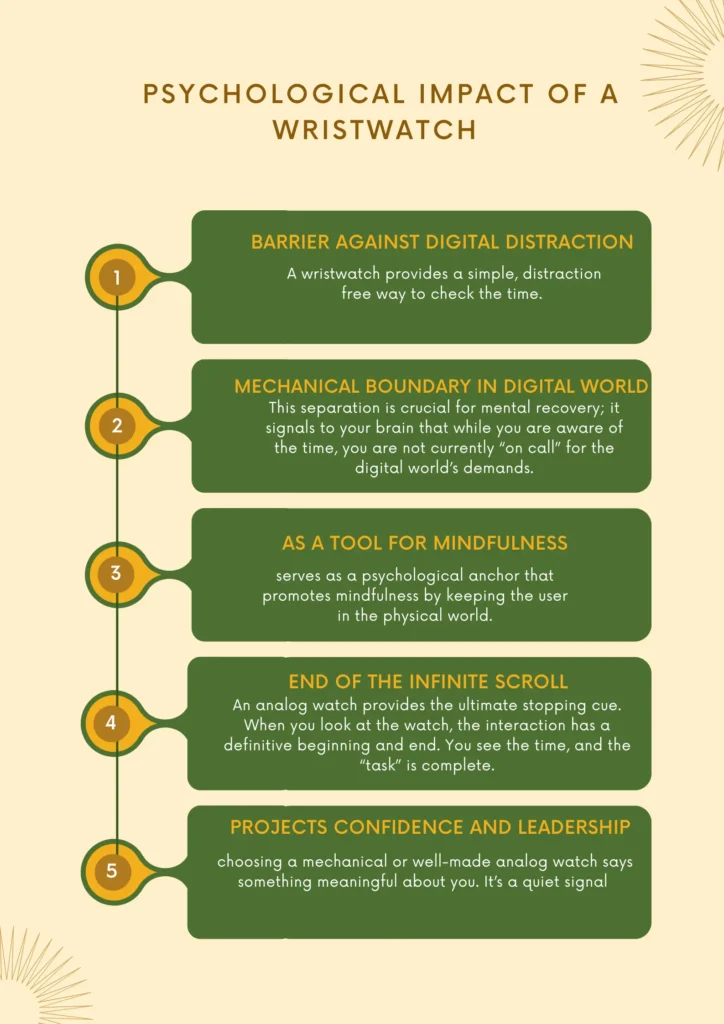
The Wristwatch: A Barrier Against Digital Distractions
One of the biggest struggles we face today is staying focused. Our go-to timepiece, the smartphone, is also our biggest source of distraction. It’s like a slot machine filled with notifications, emails, and social media alerts. Studies show that picking up your phone to check the time can lead to getting sucked into a “digital rabbit hole” that eats up ten to fifteen minutes before you know it.
On the other hand, a wristwatch provides a simple, distraction free way to check the time. When you look at your wrist, it’s a quick interaction, no notifications to pull you away from what you’re doing. For a society Struggling with notification fatigue, a watch becomes a valuable tool. It helps you manage your time effectively by protecting your most precious resource: your attention.
The Comfort of the Tangible Watch
As we dive into virtual and augmented realities, there’s something comforting about the tangible, mechanical world. A mechanical watch is a living reminder of time passing it’s a “moving constant” in a sea of changing apps and disappearing files.
There’s a big difference between seeing a digital number change on a screen and watching a real hand move across a dial. That sweeping motion gives a visual cue about the flow of time itself. For someone working towards a fitness goal or racing to meet a deadline, this representation of time adds a sense of urgency. It transforms time into something real.
Creating a Mechanical Boundary in a Digital World

In the modern era of remote work, the lines between our professional and personal lives have become dangerously blurred. Our smartphones serve as both our office and our entertainment center, making it impossible to “clock out” mentally. Wearing a watch allows you to create a physical ritual of time-keeping that is independent of your workspace. When you can track the passing of your afternoon without touching a device that contains your work emails, you establish a psychological boundary. This separation is crucial for mental recovery; it signals to your brain that while you are aware of the time, you are not currently “on call” for the digital world’s demands.
Breaking The Conditioned reflex,The Analog Watch as a Tool for Mindfulness
In 2026, many of us have developed a conditioned reflex to our smartphones, the act of reaching into a pocket triggers an expectation of a digital reward (like a “like” or a message). This constant state of “anticipatory stress” fragments our focus. Utilizing a wristwatch breaks this habitual loop. It serves as a psychological anchor that promotes mindfulness by keeping the user in the physical world. Instead of a device that demands your attention with pings and vibrations, the analog watch remains silent and passive, only providing information when you intentionally seek it. This shift from “reactive” to “proactive” time-checking is essential for maintaining long-term mental well-being.
Visual “Stopping Power” and the End of the Infinite Scroll
One of the most dangerous aspects of modern technology is the lack of “stopping cues.” Social media feeds and news sites are designed to be bottomless, keeping the brain in a state of perpetual “seeking.” An analog watch provides the ultimate stopping cue. When you look at the watch, the interaction has a definitive beginning and end. You see the time, and the “task” is complete. This creates a healthy psychological boundary that the attention economy tries to erase. By relying on a watch face rather than a screen, you train your brain to engage in short, purposeful bursts of information gathering rather than falling into the trap of passive, endless consumption.
How a Simple Watch Projects Confidence and Leadership
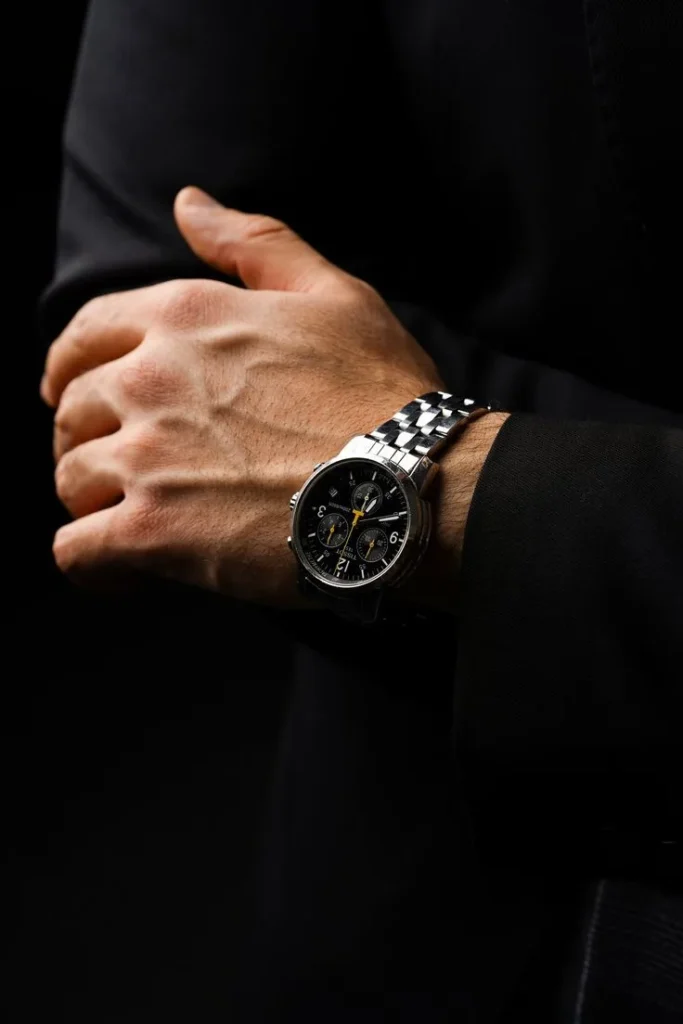
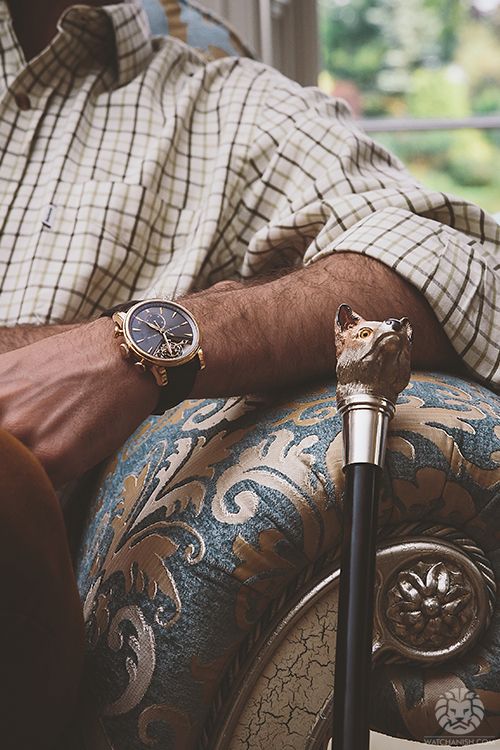
Think of this as the “handshake before the handshake.” In a world where we’re constantly surrounded by plastic, disposable tech that’s designed to be obsolete in two years, choosing a mechanical or well-made analog watch says something meaningful about you. It’s a quiet signal to a client, a boss, or a friend that you’re the kind of person who values substance over shortcuts.
When you wear a watch that was built to last, you aren’t just following a trend—you’re showing an appreciation for the “slow” art of craftsmanship. This creates what I like to call an “Expert Aura.” You walk into a room with a bit more height in your posture because you know you’re projecting stability and discernment. It tells the world that you notice the small things, like the steady sweep of a second hand, and that you understand that character is built on these tiny, consistent details. In the end, it’s not just about knowing the time; it’s about showing that you know the value of time, which is a hallmark of a true leader.
Presence Over Pings: Using a Watch to Signal Respect in Conversations
It’s easy to forget that how we check the time acts as a form of “silent body language.” We’ve all been in that moment—having a coffee or sitting in a meeting—when someone pulls out their phone. Even if they’re just checking the time, that glowing screen creates an instant wall. It subtly suggests they’re bored, distracted, or just one “ping” away from checking out of the conversation entirely.
Glancing at an analog watch, however, feels completely different. It’s a discreet, graceful gesture that doesn’t break the flow of a connection. It tells the person across from you, “I’m aware of the time, but you are my priority.” By wearing a watch, you’re signaling that you value punctuality and presence over the digital noise in your pocket. It’s a small way of showing massive respect—proving that in a world of constant pings, you’ve chosen to stay exactly where you are.
The “Watch Paradox”
We’ve all been there you glance down at your wristwatch, look away, and realized you still have absolutely no idea what time it is.
This common quirk, often called the “Watch-Check Paradox,” proves that a watch is much more than just a time-telling tool. For many of us, checking our wristwatch is a reflexive habit—a psychological security blanket or a sophisticated “fidget” that anchors us to the present moment. Instead of actually processing the hours and minutes, our brain is simply seeking a quick moment of comfort or a brief mental reset. It’s the ultimate irony of the modern watch wearer. the act of checking the time is often more about the feeling of being “ready” than it is about the numbers on the dial.