
The transition from checking your phone for the time to glancing at your wrist is a significant psychological shift. It marks the moment you stop viewing time as a digital utility, a notification distraction and start seeing it as a mechanical art form. Building a collection isn’t about how much you spend or the prestige of a logo; it’s about curating a set of tools that reflect your lifestyle, your taste, and your appreciation for engineering.
If you are ready to move beyond having just wristwatch and want to start a collection, you are entering a world of micro-mechanics, history, and personal expression. Here is how to lay a solid foundation for a lifelong journey.
1. The Philosophy of the Collection: Identifying Your Core Aesthetic
The first thing before buying your first piece, you must perform a “lifestyle audit.” A collection should complement your life, not clash with it. A common mistake is buying a watch because it looks beautiful in a professional photograph, only to realize it doesn’t fit your daily routine or wardrobe.
Most collectors fall into one of three primary aesthetic camps:
- The Minimalist: You prefer clean dials, thin cases, and simple leather straps. You likely value the functionalist, minimalist, and modernist, design language where form follows function. Your wardrobe consists of neutral tones, and you appreciate objects that don’t shout for attention.
- The Adventurer: You are drawn to rugged builds, high water resistance, and brushed steel. You want a watch that looks better with a few scratches—a “tool watch” that suggests a life lived outdoors.
- The Technician: You are fascinated by complexity. You gravitate toward stopwatches (chronographs), multiple time zones (GMTs), and busy, functional dials. You don’t just want to know the time; you want to know the rate of your heart or the time in Tokyo.
Understanding which of these strikes a chord with you will prevent “buyer’s remorse” and ensure your collection feels cohesive.
2. The Three-Pillar Strategy: The Holy Trinity of Versatile Collection
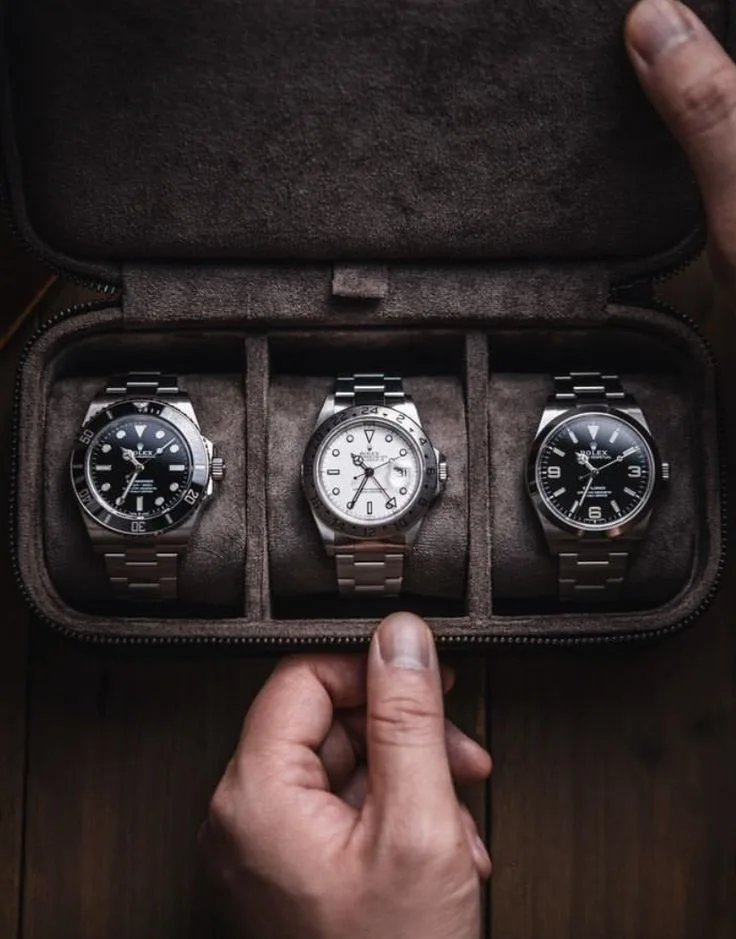
You don’t need a dozen pieces to have a “complete” assortment. In fact, most seasoned enthusiasts find that a well-chosen trio is the sweet spot for 99% of life’s scenarios. This strategy ensures you are prepared for everything from a boardroom meeting to a weekend hike.
Pillar I : The Everyday Versatile (The “GADA” Watch)
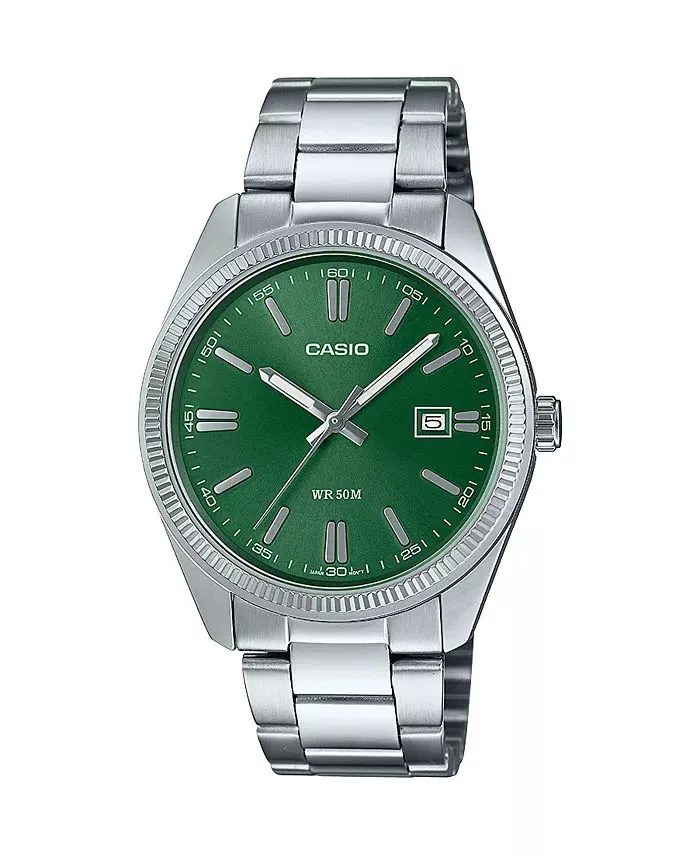
The “Go Anywhere, Do Anything” (GADA) wristwatch is the anchor of your Range. This is the piece you wear 70% of the time.
- Characteristics: Usually featuring a stainless-steel bracelet and a dial color like navy, black, or silver. It should have at least 100 meters of water resistance (meaning it’s safe for a swim) and a case size between 36mm and 40mm.
- The Vibe: It bridges the gap between casual and formal. It looks just as good with a plain t-shirt as it does with a blazer. It is the reliable companion that becomes synonymous with your presence.
Pillar II: The Formal Essential (The Dress Watch)
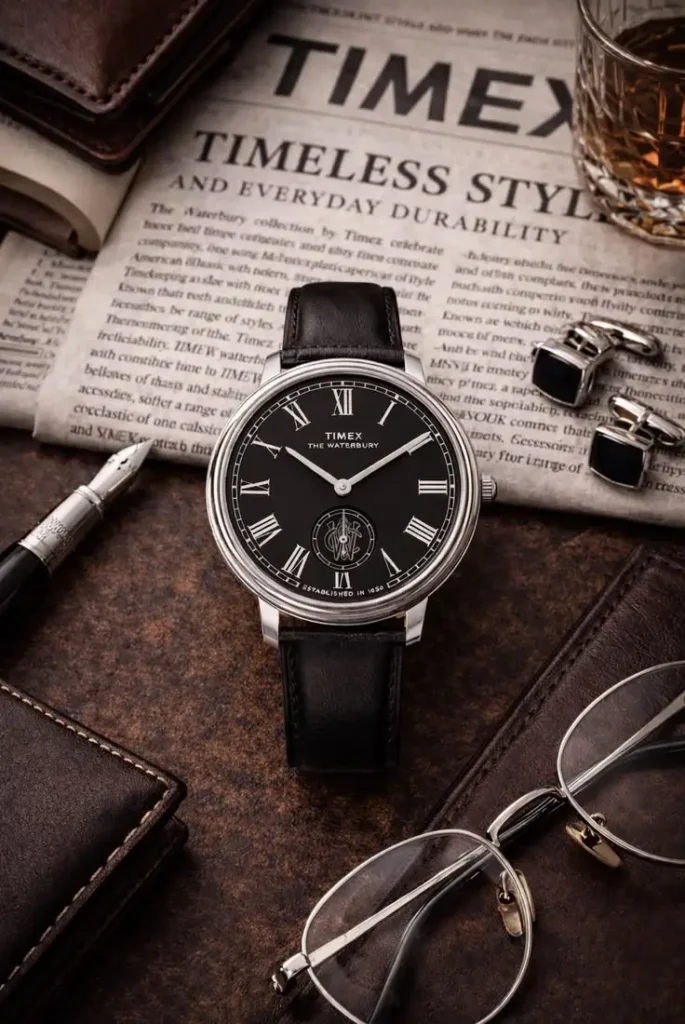
This piece is reserved for life’s milestones: weddings, high-stakes interviews, and evening events.
- Characteristics: The goal here is “discretion.” It is typically slimmer (under 10mm thick) to slide easily under a shirt cuff. It almost always features a leather strap and a clean, uncluttered face, often without a second hand or a date window to maintain perfect symmetry.
- The Vibe: Elegance through subtraction. It doesn’t need to be expensive, but it must be refined. In a world of oversized gadgets, a small, gold or silver-toned dress watch is a powerful statement of class.
Pillar III: The High-Utility Piece (The Beater)
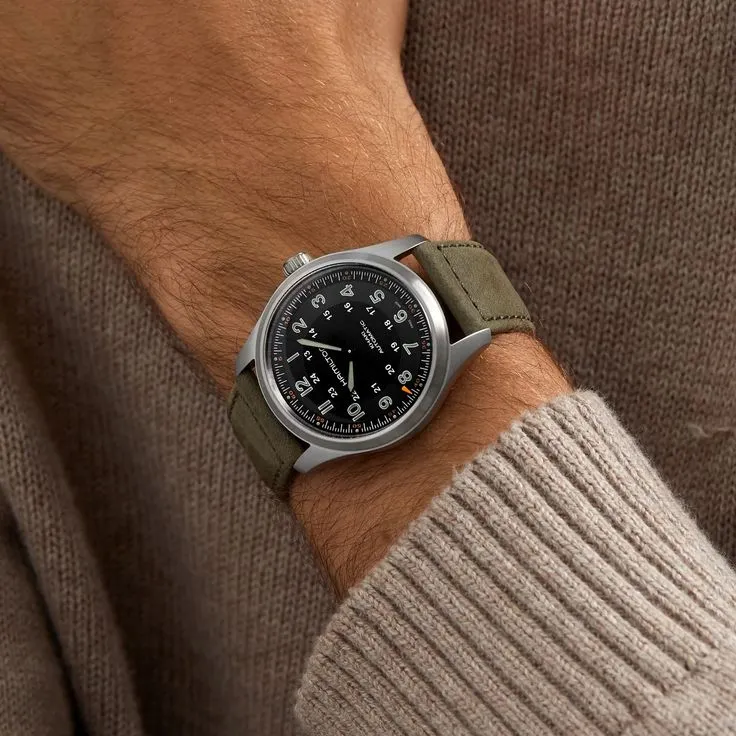
This is the timepiece you wear when life gets messy. Whether it’s a dedicated diver’s watch with a rotating bezel or a reinforced field watch, it should be built to handle shocks, water, and grit.
- Characteristics: High durability is key. Materials like sapphire crystal (for scratch resistance), screw-down crowns, and perhaps even titanium or resin for weight reduction.
- The Vibe: Pure functionality. This is the watch that records your personal bests, accompanies you on road trips, and survives the chores you’d never subject your dress watch to.
3. Powering Your Collection: Choosing the Right Movement for Your Collection
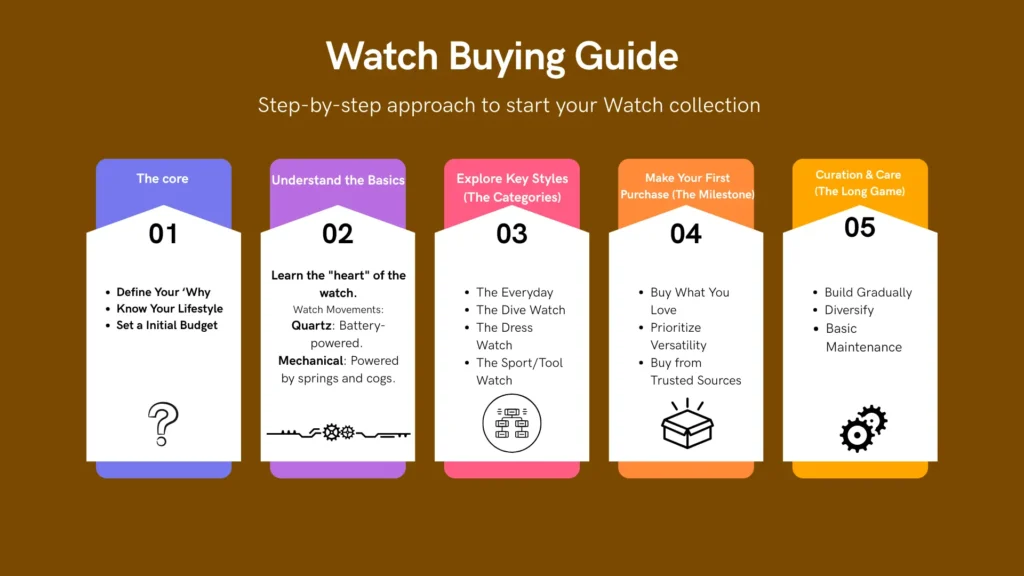
One of the first technical decisions you’ll face is choosing the “heart” of the watch. In horology, the movement is what separates a fashion accessory from a timepiece.
- Mechanical (Manual Wind): For those who love the ritual. There is a romanticism in winding your watch every morning, feeling the tension of the mainspring through your fingertips. It connects you to 18th-century engineering.
- Automatic (Self-Winding): The most popular choice for enthusiasts. A weighted rotor spins every time you move your arm, winding the watch automatically. It offers the beauty of a mechanical engine with the convenience of daily wear.
- Quartz (Battery Powered): For those who value extreme precision and a “grab-and-go” lifestyle. While purists sometimes look down on quartz, its reliability is unmatched. Modern “solar” quartz watches never even need a battery change, making them the ultimate low-maintenance tool.
Know Your Watch Movement
4. Finding Your ‘Goldilocks’ Watch: A Guide to Watch Proportions
A watch that doesn’t fit is a watch that doesn’t get worn. To avoid the mistake of buying a “wrist plate,” pay attention to these three metrics:
- Case Diameter: For most men, 38mm to 42mm is the “goldilocks” zone. Smaller wrists (under 6.5 inches) generally look better with 34mm-38mm cases.
- Lug-to-Lug: This is the most underrated measurement. It is the distance from the top tip of the frame to the bottom tip. If this distance is wider than the flat surface of your wrist, the lugs will “overhang,” making the watch feel cumbersome and look awkward.
- Thickness: A 15mm thick watch might look cool, but it will snag on every doorframe and sleeve. If you want a daily wearer, aim for something between 10mm and 13mm.
5. Quality Always Wins: Tip for a Long-Lasting Wrist Watch Collection
As you begin your journey, the temptation to buy five inexpensive “fashion watches” in your first month will be high. Resist this. This is known as “filling slots,” and it’s the fastest way to build a collection you’ll eventually want to sell at a loss.
Instead, embrace Quality Over Quantity.
One well-made timepiece featuring a sapphire crystal (which is virtually unscratchable compared to mineral glass) and a reliable movement (from reputable Japanese or Swiss manufacturers) will bring more long-term satisfaction than a drawer full of watches that won’t last a year.
The Rule of Three Months: If you see a watch you love, wait three months. Research its history, look at “real world” photos (not just the brand’s renders), and see if the spark remains. If it does, you’ve found a keeper.
6. Chasing the Wristwatch: Research and Community
Collecting is about more than just ownership; it’s about the hunt the chase. Part of the story of your watch is how you found it. Did you spend weeks lurking on forums? Did you find a vintage gem in a small shop? Did you save for a year to celebrate a promotion?
Engage with the community. Watch enthusiasts are among the most passionate hobbyists in the world. Whether it’s reading about the history of the moon watch, the evolution of dive timers, or the metallurgy of 904L steel, the knowledge you gain makes the object on your wrist more meaningful.
7. Beyond the Wristwatch: Straps and Customization
One of the best-kept secrets in watch collecting is that a new strap is a new watch. You can completely change the personality of your “Everyday Versatile” piece by swapping a steel bracelet for a rugged leather strap or a nylon NATO strap. This is a cost-effective way to keep your collection feeling fresh without spending thousands on a new timepiece.
Final Thought: The Story on Your Wrist
A watch collection is a slow burn. It’s a physical timeline of your tastes, your travels, and your achievements. Your first watch shouldn’t be the one the internet tells you is “cool” or “an investment” it should be the one that makes you smile every time you check the time.
The most valuable watch in the world isn’t the one that costs the most at auction; it’s the one that was on your wrist during your greatest adventures. As you start this journey, ask yourself: What’s the one feature I prioritize most? Is it the rugged durability that can survive a mountain climb, the sleek aesthetics that command a room, or the intricate mechanics that remind me of human creativity?
Whatever your answer, let your collection be a reflection of who you are, one tick at a time
If you liked the blog, Read more