
Spend any real time around mechanical watches, and you’ll figure out fast that telling time is only half the job. The second a timepiece does something beyond showing hours, minutes, and seconds, you’ve stepped into the world of watch complications.
A complication is simply any watch feature that does something other than tell you what time it is — a hand that tracks a second time zone for pilots, a display that maps the phases of the moon. Either way, it’s tiny mechanical engineering turned into something you’d actually call art.
Whether you’re eyeing your first luxury watch or just trying to make sense of the jargon, here’s a beginner’s rundown of the complications you’ll run into most: GMTs, chronographs, tachymeters, perpetual calendars, and a few others.
What Is a Chronograph?
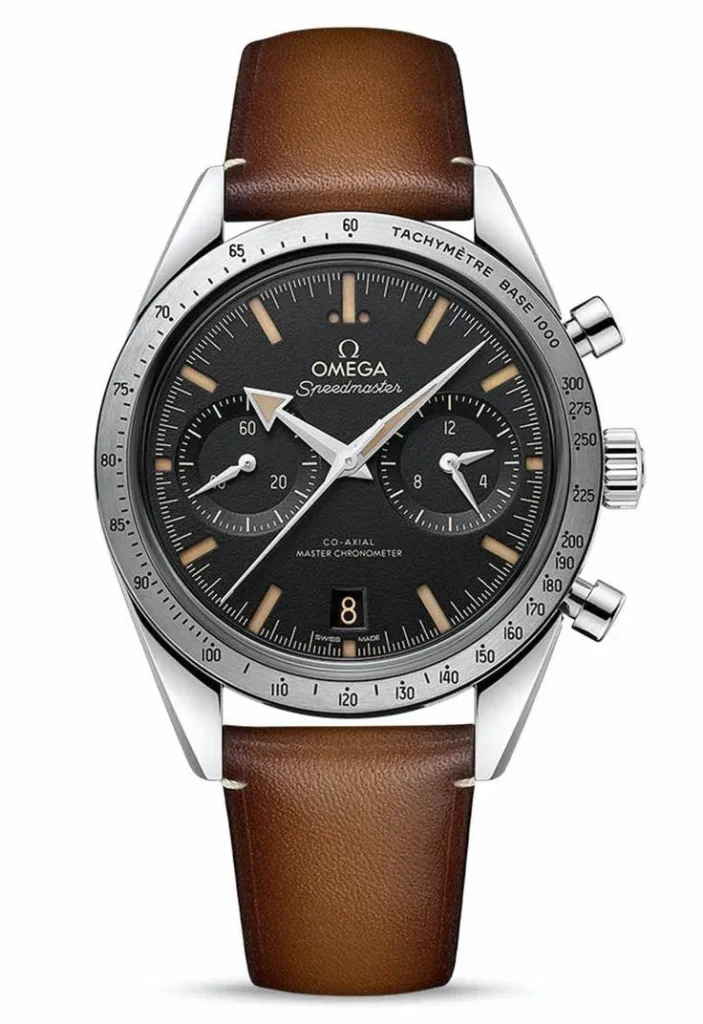
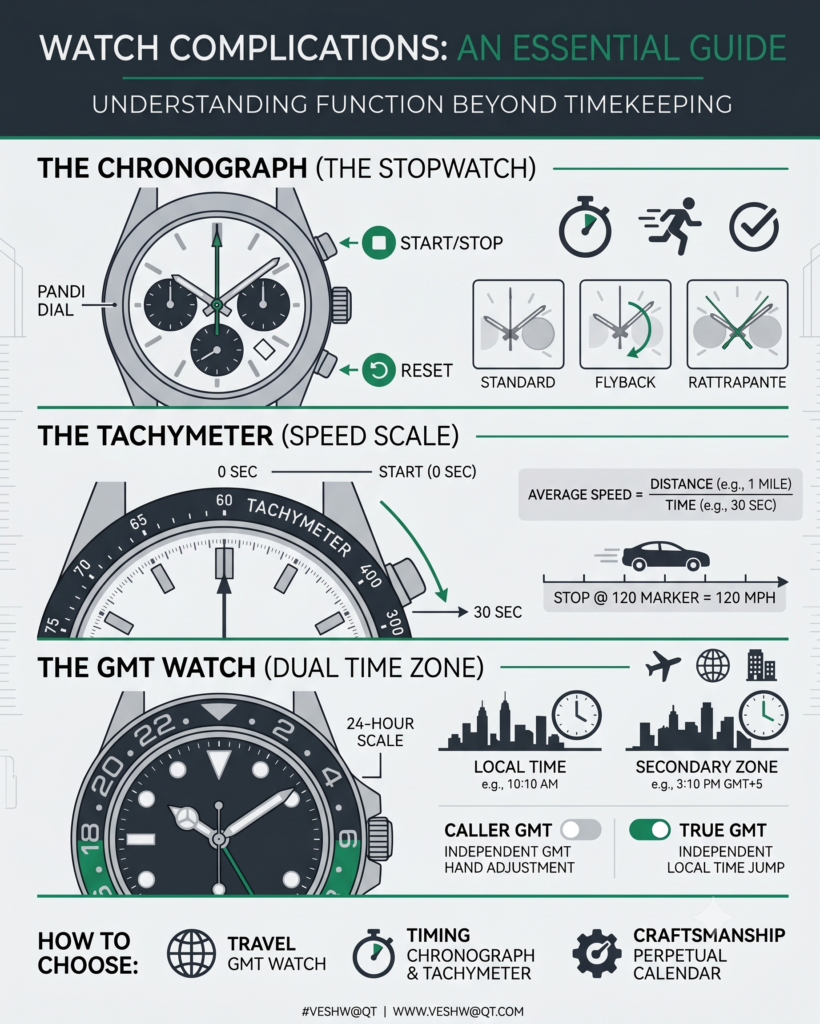
The chronograph might be the most common — and most loved — complication out there. Strip away the jargon, and it’s really just a stopwatch built into the movement.
How it works
Most chronographs have two pushers on the case, sitting at 2 and 4 o’clock on either side of the crown.
- Top pusher (2 o’clock): starts and stops the central chronograph hand.
- Bottom pusher (4 o’clock): resets the hand and any sub-dials to zero.
Once running, small sub-dials called registers keep tally of elapsed minutes and hours, while the big sweeping hand does the actual second-by-second timing.
A few common types
- Standard chronograph: two pushers, start-stop-reset, nothing fancier.
- Flyback chronograph: built for pilots. One press of the reset button while it’s running snaps the hand to zero and starts it again, skipping the usual sequence.
- Rattrapante (split-seconds): two central hands stacked on each other. A third pusher freezes one hand to catch a lap time while the other keeps running.
What Is a Tachymeter?
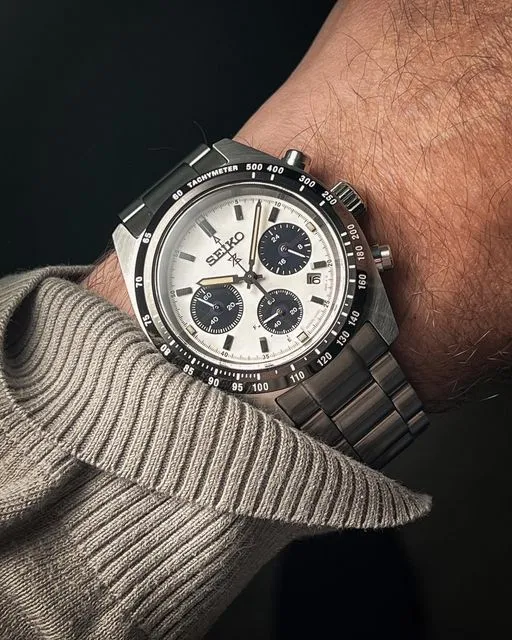
People often assume a tachymeter is its own complication, but it’s really just a scale, printed or engraved around the bezel of a chronograph watch.
How you’d use one
A tachymeter works out speed based on how long it takes to cover a fixed distance, usually a mile or a kilometer, using a simple formula:
$$\text{Speed} = \frac{3600}{\text{Elapsed Time in Seconds}}$$
In practice: start the pusher as a car crosses Mile 0, stop it at Mile 1, then read where the hand lands on the bezel — that’s the average speed. Cover a mile in 30 seconds, and the hand lands on 120, meaning 120 mph.
What Is a GMT Watch?
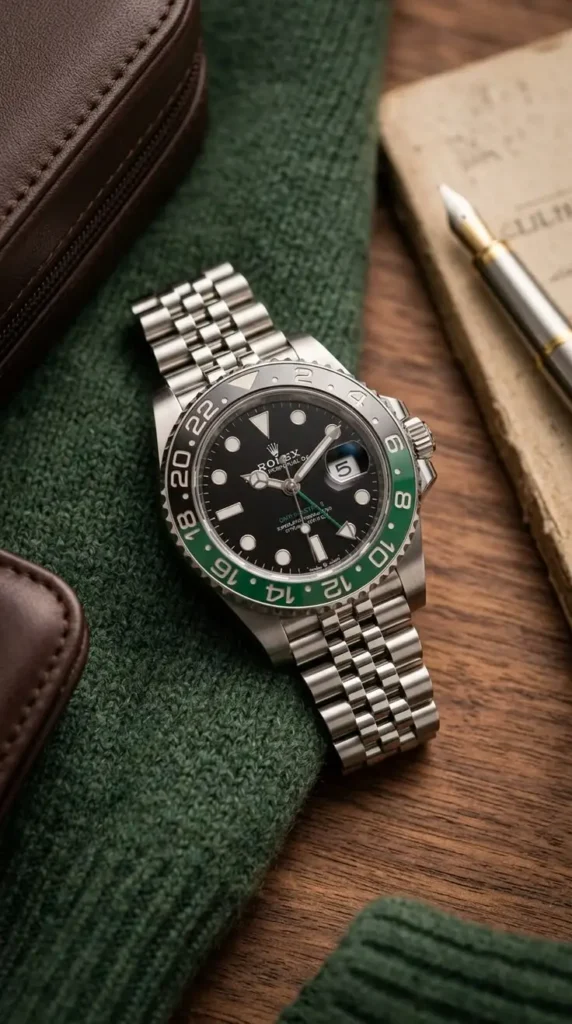
The GMT complication showed up during the 1950s jet age, built to help transatlantic pilots track more than one time zone at once.
How it works
A GMT watch runs four hands instead of the usual three:
- Hour hand (12-hour format)
- Minute hand
- Second hand
- GMT hand (24-hour format)
That extra GMT hand makes one full trip around the dial every 24 hours, pointing to a 24-hour scale on the bezel. Because it runs on a full cycle, it lets you tell AM from PM in that second time zone — something a standard 12-hour hand can’t do alone.
Caller GMT vs. True GMT
- Caller GMT (office GMT): the crown moves the 24-hour GMT hand in one-hour steps. Ideal for anyone regularly on calls with people in other time zones.
- True GMT (flyer GMT): the crown jumps the main local-time hand forward or back without touching the running seconds, so frequent travelers can reset local time the moment they land.
The Masterpiece of Timekeeping: The Perpetual Calendar
A basic date window needs manual correcting at the end of any month shorter than 31 days — February trips it up even more. A calendar complication handles that automatically, to varying degrees.
How the calendar complications stack up
| Complication | Tracks Month Lengths? | Tracks Leap Years? | Manual Adjustment Needed |
| Simple Date / Day-Date | No | No | 5 times a year (every month under 31 days) |
| Annual Calendar | Yes (30 vs. 31 days) | No | Once a year, on March 1st |
| Perpetual Calendar | Yes (30 vs. 31 days) | Yes | Once every 100 years (2100) |
Perpetual calendars handle the regular four-year leap year cycle on their own. The one exception is century years not divisible by 400 — like 2100 — which the Gregorian calendar skips as leap years, so even a perpetual calendar needs a nudge on March 1, 2100.
A Few More Complications Worth Knowing
Chronographs, GMTs, and calendars get most of the spotlight, but horology has plenty of other clever mechanics — some practical, some purely for the love of it.
1. Moon phase
Shows where the moon is in its cycle — new, waxing, full, waning — through a small window on the dial. Sailors once relied on it for reading tides; today it sticks around mostly for being one of watchmaking’s most beautiful complications.
2. Power reserve indicator
Basically a fuel gauge for your watch. A small sub-dial or linear meter shows how much energy is left in the mainspring, ranging anywhere from 38 hours to a full 8 days.
3. Minute repeater
Push a slide lever and the watch chimes out the time using tiny hammers striking gongs inside the case — distinct tones for hours, quarter-hours, and minutes.
4. Tourbillon
Not technically a complication so much as a regulating mechanism, the tourbillon spins the balance wheel and escapement inside a rotating cage, usually completing one rotation per minute. Abraham-Louis Breguet invented it in 1795 to counter how gravity threw off pocket watch accuracy.
Summary: Choosing the Right Complication for You
At the end of the day, complications are what give a mechanical watch its personality, its story, and its usefulness beyond just telling time.
- GMT if you cross time zones often or stay in touch with people who do.
- Chronograph and tachymeter if motorsport and precise timing are your thing.
- Perpetual calendar or moon phase if what draws you in is pure mechanical craftsmanship.
Enjoyed this post? Check out more articles on the blog for similar insights!
Follow Veshwaqt on Instagram!