Here’s the thing about getting dressed well and shoes: you can nail everything else — the tailored suit, the perfect pair of raw denim, that leather jacket you saved up for — and still watch the whole outfit fall apart because of one bad shoe choice. Your feet are the anchor of your entire look. People clock them almost without thinking, and whether an outfit actually reads as “put together” often comes down to what’s on your feet. Swap in a crisp pair of leather Oxfords and even the simplest trousers suddenly look intentional. Swap in scuffed, mismatched sneakers, and that same outfit falls apart.
Shoes aren’t just the finishing touch — they’re doing a lot of talking. They tell people whether you understood the dress code, whether you’re playfully bending it, or whether you didn’t think about it at all. It’s a small, silent signal of effort, and it registers before anyone reads a single other detail of the outfit. Getting good at footwear isn’t really about owning a lot of shoes. It’s about understanding formality, texture, and shape well enough to build a style that feels effortless, so you’re never scrambling to figure out what goes with what.
So let’s walk through the shoe hierarchy — everything from the most formal Oxfords down to your go-to Chelsea boots — so you always know which pair the moment calls for.
Level 1: Black Tie & Strict Formal — Oxfords & Opera Pumps
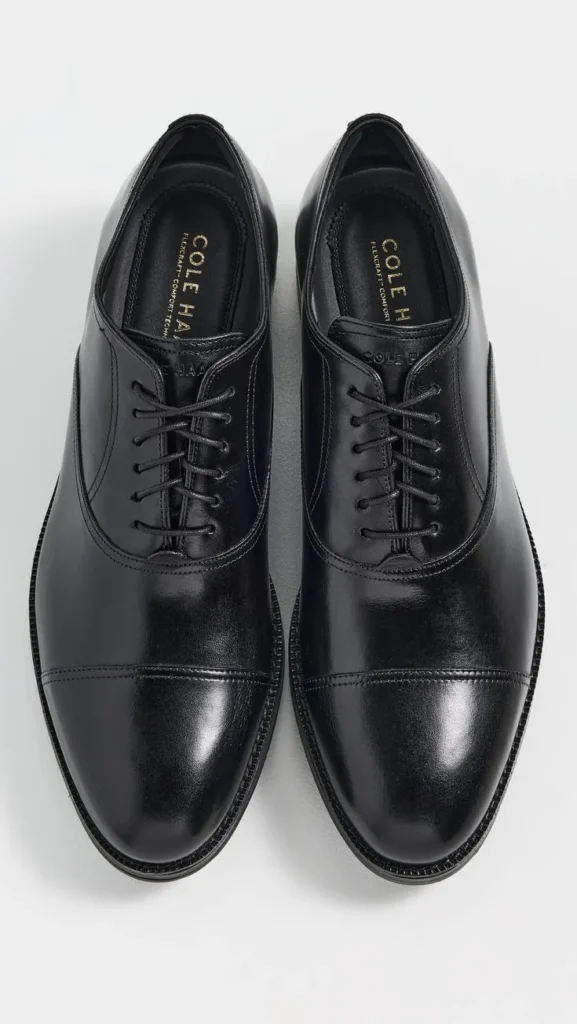
When the dress code says strict formal or black tie, your shoes need to match that energy exactly. This is Oxford and Opera Pump territory.
The Oxford is the classic men’s dress shoe, and what sets it apart is the “closed lacing” system — the eyelets are stitched underneath the vamp rather than on top of it. That construction doesn’t leave much room to adjust once they’re laced, so fit really matters here. You want a pair that matches your foot’s length and width closely, or you’ll feel it by the end of the night.
Oxfords come in a handful of styles — plain toe, wholecut, cap-toe, wingtip, brogue — but for anything truly formal, stick to the cleanest options: cap-toe or wholecut.
If you want to go even further, there’s the Opera pump, sometimes called a dress pump. These are reserved for white tie and black tie only — low-cut slip-ons, usually in glossy black patent leather, finished off with a grosgrain or silk bow.
They’ve been around since the 18th century, and that deep, scooped cut shows off a sliver of dress sock, giving tuxedo trousers or tailcoats a long, clean line. Plenty of modern dress codes have moved toward patent Oxfords or velvet loafers instead, but the opera pump is still the gold standard for anyone who takes black tie seriously.
Level 2: Business & Smart Casual — Derby Shoes & Monk Straps
One step down from black-tie formality, you land on the real workhorses of a sharp wardrobe: Derbies and Monk straps. These are the shoes that carry you through the office, business meetings, cocktail hours, and dressed-up weekends alike.
At a glance, a Derby looks a lot like an Oxford, but the lacing gives it away. Derbies use “open lacing,” where the eyelet facings sit on top of the shoe rather than underneath. That small change makes the shoe more relaxed and far more adjustable — great news if you’ve got wider feet or a higher instep. Whether it’s smooth calfskin or soft suede, a good Derby strikes that balance between polished and comfortable.
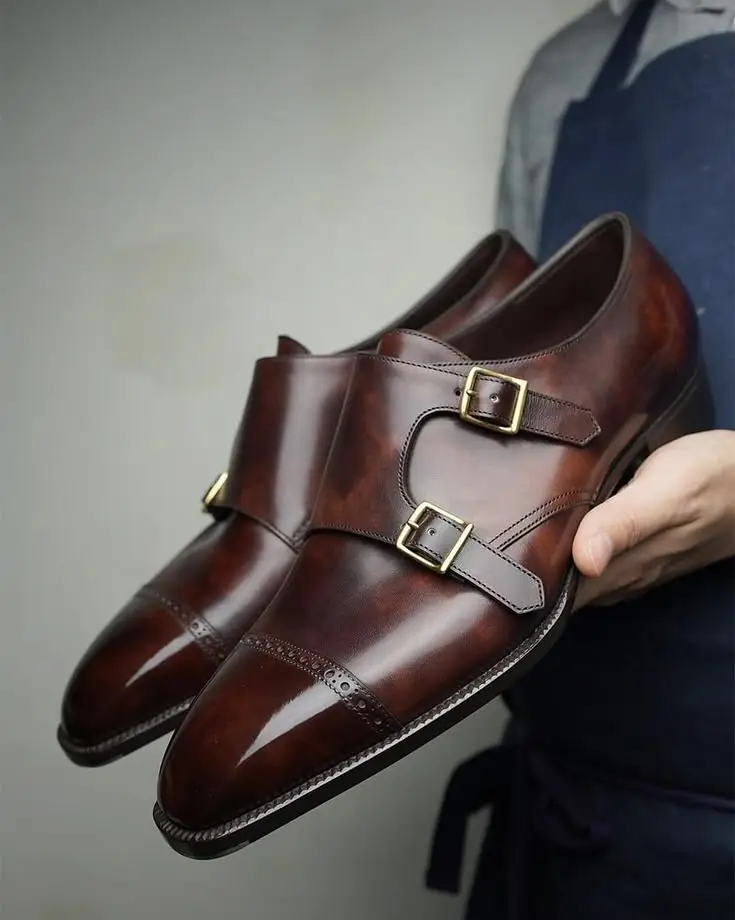
If you want a little more personality without losing the formal edge, that’s where Monk straps come in. Instead of laces, you get a leather flap across the instep held down by one or two metal buckles — single or double monk, depending on the style.
They actually trace back to European monks looking for something sturdier than sandals, and today they sit right at the intersection of formal and casual. Try a dark brown double monk with a navy suit for a modern office look, or pair them with dark denim and a blazer for something more relaxed.
Level 3: Smart Casual & Versatile Everyday — Loafers & Dress Boots
This is the sweet spot — the shoes that can go from a casual Friday at work to dinner with someone you’re trying to impress, no wardrobe change required.
Start with the Loafer, easily the most versatile slip-on out there. No laces, exposed ankle, effortless by design. And there’s real range within the category:
- Penny Loafers: The classic — a leather strap across the front with that signature decorative slit. Works for preppy, business-casual, or smart-casual looks alike.
- Tassel Loafers: Same laid-back ease, but with tassels dangling from the vamp for a bit more character and old-school charm.
When it gets colder, or you just want a bit more edge, reach for dress boots instead. Unlike a work boot, these stay slim and clean-lined, so they still sit neatly under tailored trousers or fitted jeans.
The two to know are the Chelsea boot — laceless, with elastic side panels so you can slip them straight on — and the Chukka (or desert boot), a suede lace-up that stops at the ankle. Chelsea boots look great with dark denim and a leather jacket for evening plans; suede Chukkas pair easily with chinos for something more low-key. Both manage to look deliberate without trying too hard, which is really the whole appeal of this level.
Level 4: Casual & Off-Duty Essentials — Sneakers & Everyday Classics
At the bottom of the hierarchy — though “bottom” doesn’t mean unimportant — you’ve got the everyday staples: casual sneakers and off-duty shoes. Dress codes have loosened up a lot, and a good sneaker, chosen and worn well, can actually add a clean, youthful edge to an outfit.
The clear MVP here is the minimalist leather sneaker. Think crisp white or neutral low-tops in quality leather or suede — a blank canvas that works just as well with a slim suit as it does with chinos or dark denim. The one rule: keep them clean. A scuffed white sneaker undoes the whole point.
Beyond that, a few more everyday go-tos round out the category:
- Retro & Heritage Runners: Athletic-inspired shapes that bring a streetwear feel to weekend tees and hoodies.
- Canvas Low-Tops: Your Converse and Vans — simple, lightweight, and built for warm weather.
- Espadrilles & Boat Shoes: Breathable slip-ons made for summer, the beach, and doing absolutely nothing productive.
Mastering this level isn’t about steering clear of casual shoes — it’s about knowing where their limits are. Keep the performance running shoes for actual workouts, and let clean, low-profile sneakers carry your everyday style instead.
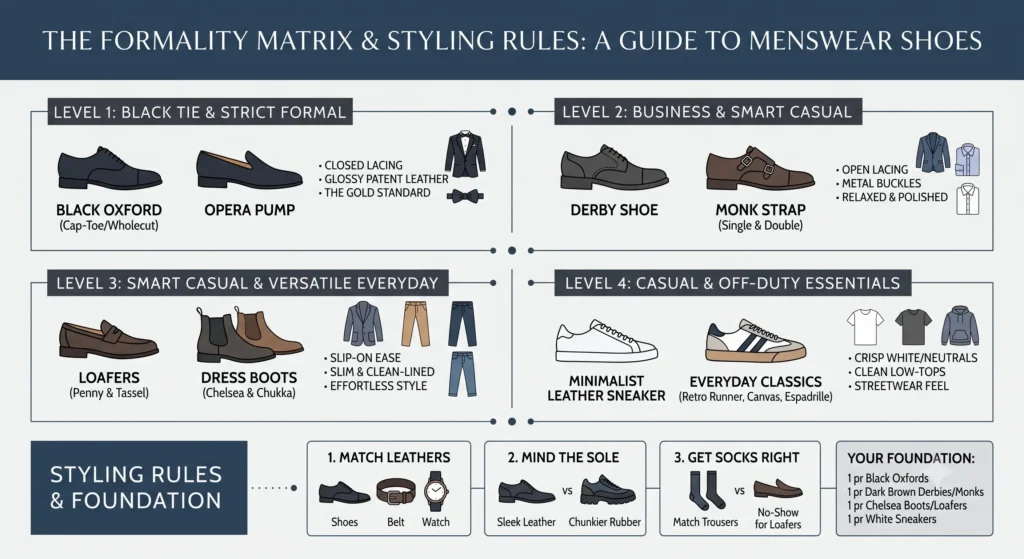
The Formality Matrix & Styling Rules
A few rules that will never steer you wrong:
- Match your leathers. Shoes, belt, and watch strap should all live in the same colour family — black with black, brown with brown.
- Mind the sole. Sleek leather soles belong with formal Oxfords and tailored suits. Chunkier rubber or lug soles bring the formality down a notch, which makes them right at home on smart-casual boots and everyday shoes.
- Get the socks right. For anything formal or business-related, match your socks to your trousers to keep the leg line long. Save no-show socks for loafers and warm-weather sneakers only.
Follow these three, and your shoes will do their job every time.
Building Your Foundation
You don’t need thirty pairs of shoes to dress well — you need the right ones for the situations you actually run into. Quantity was never really the point.
Once you understand the hierarchy, a small, versatile collection covers almost everything:
- One pair of black formal Oxfords for weddings, funerals, and anything strictly formal.
- One pair of dark brown Derbies or Monk straps for the office and smart-casual dinners.
- One pair of Chelsea boots or loafers for easy weekend wear and date nights.
- One pair of clean, minimalist white leather sneakers for everything off-duty.
Build from there and getting dressed stops being a decision — it just works. Invest in good leather, take care of it, and the right pair of shoes will do more than complete an outfit. It’ll make it.
Enjoyed this post? Check out more articles on the blog for similar insights!
Follow Veshwaqt on Instagram!