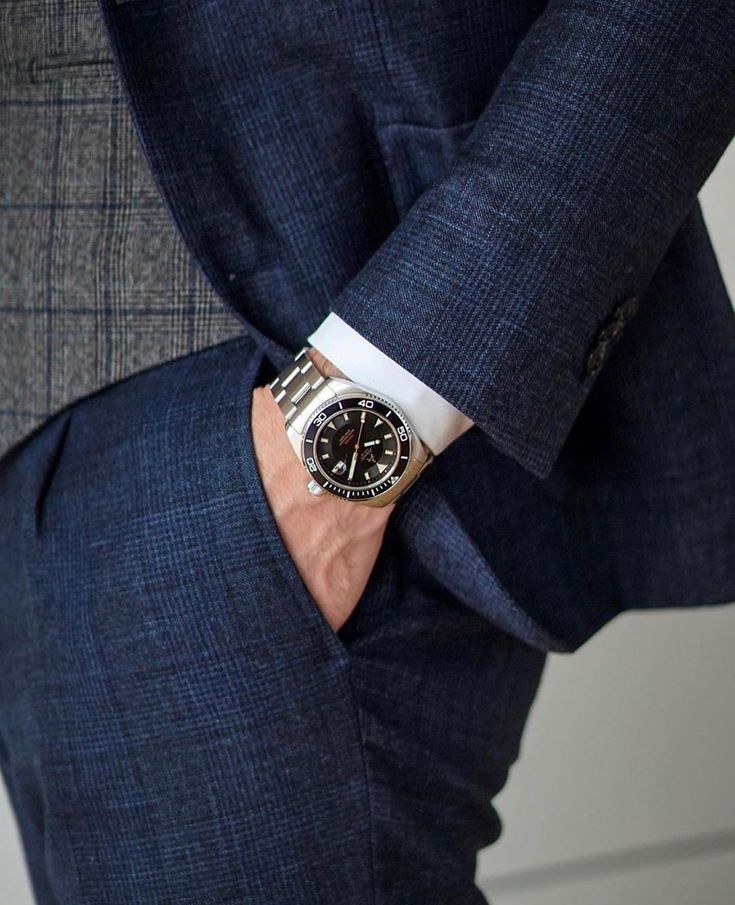
There was a time when strapping a steel dive watch or a hefty chronograph onto your wrist with a tailored suit was practically a fashion crime. The old rulebook said formal wear called for a thin, two-hand dress watch on a black alligator strap — something quiet enough to disappear under a double cuff.
That rulebook doesn’t really apply anymore. Between the general loosening of dress codes and the cult status of watches like the Audemars Piguet Royal Oak and the Patek Philippe Nautilus, mixing tool watches with tailored jackets has become one of the clearest signals of modern smart-casual style.
Get it right and a sports watch gives structured tailoring a looser, more current feel. Get it wrong and you end up with a chunk of hardware fighting against soft fabric. Nailing the combination comes down to proportions, materials, colors, and a handful of small details.
1. The Foundation: Cuff Clearance and Proportions
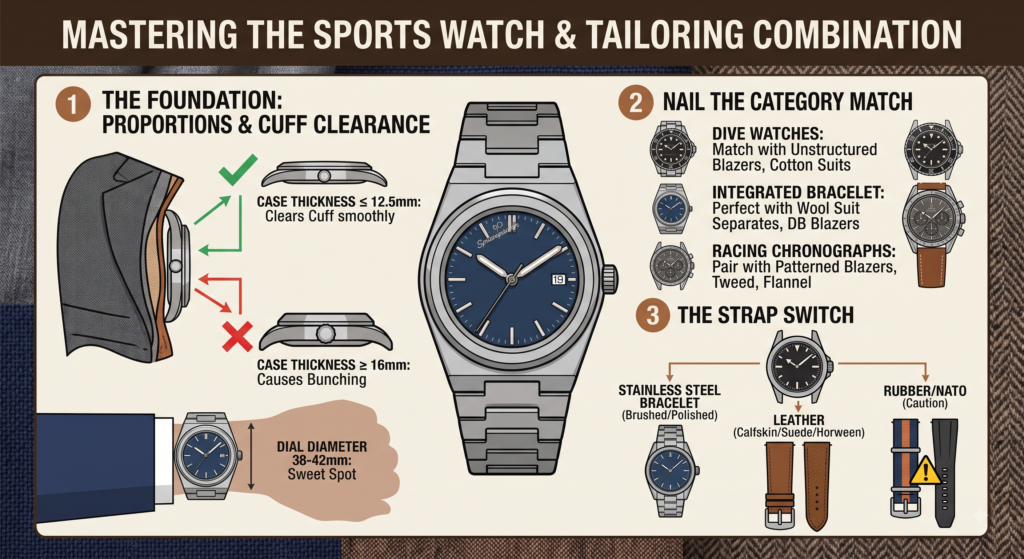
Before you even start thinking about which style of watch to wear, deal with the one thing that matters more than anything else: how thick the case is and whether it’ll clear your cuff.
Suit jackets and blazers depend on clean lines with nothing interrupting them. A watch case pushing 16mm with an oversized crown and heavy guards is going to catch on your shirt cuff, throw off the sleeve break, and bunch up the fabric in a way that just looks off.
Numbers worth keeping in mind:
- Case thickness: Try to stay at or under 12.5mm for a standard shirt cuff. If you’re set on something in the 13–14mm range, go for shirts with adjustable cuff buttons, or wear it with an unbuttoned surgeon’s cuff on more casual blazers.
- Lug-to-lug distance: The lugs shouldn’t overhang your wrist. When they do, the watch gets pushed outward and the cuff can’t sit naturally over it.
- Dial diameter: For most wrists, 38mm to 42mm is the sweet spot under a jacket. Go much bigger and you start drifting out of smart-casual territory into purely casual.
2. Navigating the Sports Watch Categories
Not every sports watch is built the same way, and the personality of the watch needs to match the structure of what you’re wearing over it.
The Luxury Dive Watch
Examples: Rolex Submariner, Omega Seamaster Diver 300M, Tudor Black Bay 58
Best paired with: Unstructured navy blazers, tailored cotton suits, deconstructed wool jackets.
How to wear it: This is the most common tool watch to see with tailoring, thanks in no small part to James Bond. Keep to glossy black, dark blue, or clean white dials with a slim ceramic or steel bezel. Skip the oversized “tool-first” divers with 1000m+ ratings and helium release valves — those slab sides will chew up a shirt cuff fast.
The Integrated Bracelet Sports Watch
Examples: Royal Oak, Vacheron Constantin Overseas, IWC Ingenieur, Tissot PRX
Best paired with: Double-breasted blazers, sharp wool suit separates, high-twist wool tailoring.
How to wear it: This category was invented in the 1970s specifically to close the gap between sporty and formal. A slim case, geometric shape, and fluid metal bracelet mean it slides easily into smart-casual and business-casual looks without a fight.
The Racing Chronograph
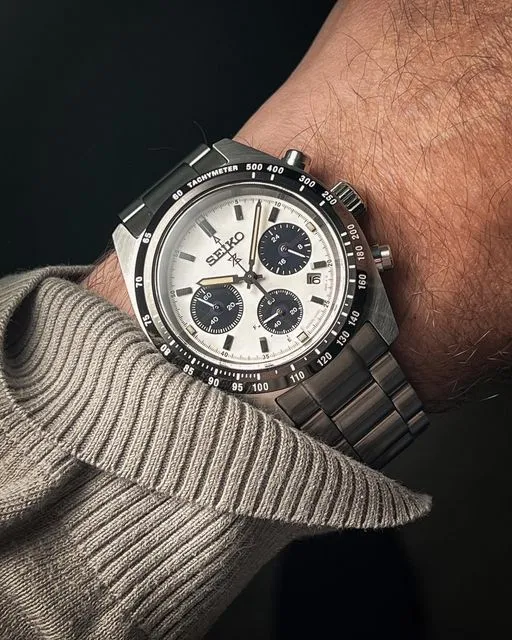
Examples: Omega Speedmaster Professional, TAG Heuer Carrera, Rolex Daytona
Best paired with: Patterned blazers (Prince of Wales check, houndstooth), tweed jackets, flannel suits.
How to wear it: Chronographs have a busy, mechanical look — sub-dials, tachymeter bezels, that sort of thing. Pair that visual complexity with fabrics that have their own texture and depth, like autumn wools or hopsack.
3. Quick-Reference Pairing Matrix
Here’s a cheat sheet for matching suit formality to watch type and strap:
| Tailoring Style | Formality Level | Recommended Watch Type | Ideal Strap Material | Color Palette |
|---|---|---|---|---|
| Worsted Navy/Charcoal Suit | High Business Casual | Integrated Bracelet / Slim Diver | Steel Bracelet, Smooth Calfskin | Black, Dark Blue, Slate |
| Unstructured Linen Suit | Summer Smart-Casual | GMT / Vintage Field Watch | Perlon, Textured Leather, NATO | Tan, Champagne, Olive |
| Flannel / Tweed Blazer | Autumn/Winter Casual | Racing Chronograph / Field | Horween Leather, Suede, Canvas | Brown, Cream, Matte Black |
| Cotton Suit Separates | Everyday Smart-Casual | Modern Diver / Integrated | Rubber (Integrated), Bracelet | Navy, Green, Silver |
4. The Strap Switch: Elevating Casual Tool Watches
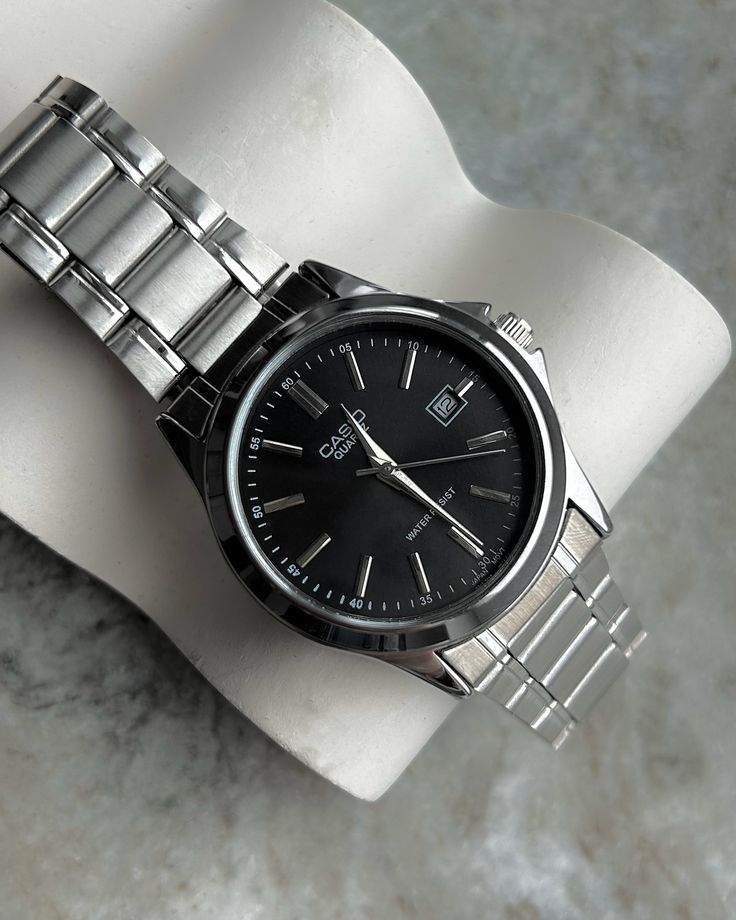
The strap does most of the heavy lifting when it comes to how formal a watch looks — probably more than half the equation. Swap the strap and you can take a rugged tool watch and make it suit-ready without touching anything else.
Stainless Steel Bracelets
Steel works with almost anything in a smart-casual context. A brushed finish tones down a shiny suit, and polished center links can dress up a casual blazer a little. Just make sure the bracelet actually fits — a loose, sliding bracelet under a tailored jacket reads as sloppy no matter how nice the watch is.
Leather (Calfskin, Suede, and Horween)
Trade a rubber or NATO strap for good leather and the whole watch feels more put-together instantly.
- Smooth calfskin: Works best on sleek divers and chronographs with structured blazers.
- Textured suede & nubuck: Better suited to field watches and vintage-leaning chronographs, paired with unlined linen or cotton jackets.
Rubber and NATO Straps: Proceed with Caution
- Rubber straps: The integrated rubber straps you see on watches like the Aquanaut or Overseas actually work well with casual blazers. Bulky accordion-style dive straps, on the other hand, look out of place.
- NATO/fabric straps: Nylon NATOs bring a rugged, military feel. Keep them for casual linen blazers, patch-pocket jackets, and summer suits — they don’t belong with formal worsted wool.
5. Color Coordination and Metal Matching
Matching your watch to your outfit isn’t about making everything identical — it’s more about the pieces agreeing with each other.
       [ WATCH HARDWARE ]               [ MENSWEAR ACCENTS ]
   ┌────────────────────────┐       ┌────────────────────────┐
   │ • Stainless Steel Case │  <───>│ • Belt Buckles         │
   │ • Metal Bracelet       │       │ • Cufflinks            │
   │ • Buckles / Clasps     │       │ • Metal Eyewear Frames │
   └────────────────────────┘       └────────────────────────┘
- Match your metals: A steel case pairs naturally with silver-toned belt buckles, shoe hardware, or buttons. If you’re wearing a bronze or gold sports watch, lean into warmer leather tones and gold accents elsewhere.
- Anchor with the dial: A black dial goes with almost anything. Blue dials sit well against navy jackets and grey flannel. If your dial is a bolder color — green, orange, salmon — let it be the one loud element and keep the rest of the outfit calm.
- Leather-to-leather harmony: If the watch is on a leather strap, try to roughly match that leather tone to your shoes and belt — brown with brown, black with black.
6. Three Foolproof Smart-Casual Outfits
A few full combinations that put all of this into practice:
Outfit 1: The Riviera Summer Look
Tailoring: Unstructured sand-colored linen blazer, white poplin shirt worn open at the collar, navy chinos.
Watch: Vintage-inspired diver (39mm) on a textured dark blue suede strap.
Why it works: The suede strap softens the diver’s sporty edge, and the navy tone ties back to the trousers against the sand-colored blazer.
Outfit 2: The Modern Executive
Tailoring: Deconstructed dark navy hopsack suit with a fine-gauge grey merino crewneck instead of a shirt and tie.
Watch: Integrated bracelet steel sports watch, blue or silver dial.
Why it works: Losing the tie relaxes things, but the clean lines of the integrated bracelet watch keep the whole look sharp and professional.
Outfit 3: The Weekend Tailored Look
Tailoring: Olive green cotton blazer, white oxford button-down, dark denim, brown suede loafers.
Watch: Stainless steel bi-compax chronograph on a vintage brown Horween strap.
Why it works: The olive jacket and denim give a rugged base that matches the mechanical character of the chronograph’s sub-dials and the warmth of the leather strap.
Master the Balance
Pairing a sports watch with a suit or blazer comes down to intentional contrast — it says you take tailoring seriously without taking yourself too seriously. Get the case thickness right, keep the dial clean, and match your strap to the outfit’s texture, and you can wear your favourite tool watch anywhere from the office to a Saturday night out.
Enjoyed this post? Check out more articles on the blog for similar insights!
Follow Veshwaqt on Instagram!